
Brain injury evidence
Traumatic brain injury after a motor accident
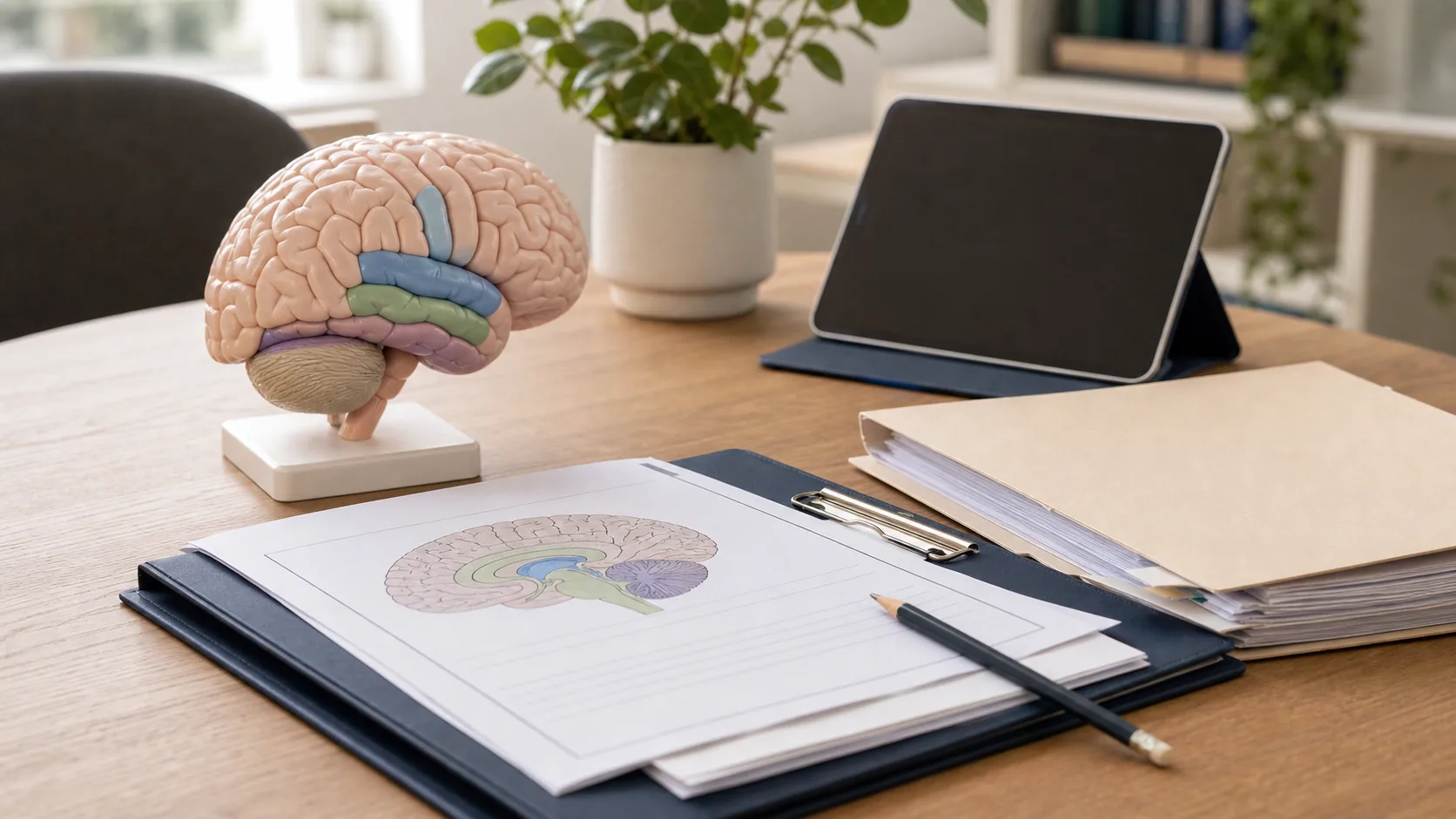
A traumatic brain injury may affect cognition, language, behaviour, awareness, movement, seizures, vision, balance or cranial nerve function. The CTP assessment is not based on the seriousness of the crash or an imaging label alone. It identifies the accident-related functional impairment, applies the correct Part 6 method and avoids counting the same loss twice.
Motor accident mechanism
What can happen in a motor accident?
Rear-end crash
High-energy acceleration-deceleration may cause diffuse or focal brain injury, including contusion or haemorrhage.
Side-impact crash
Lateral intrusion and rotational force can cause focal impact injury, diffuse axonal injury or cranial nerve damage.
Motorcycle fall
Direct head impact, rotation and loss of consciousness may occur despite helmet use.
Pedestrian impact
A person may sustain direct head trauma and secondary ground impact together with facial or spinal injury.
Injuries and diagnoses that may follow
- cerebral contusion, traumatic haemorrhage or diffuse axonal injury
- cognitive or communication disorder from organic brain injury
- post-traumatic epilepsy or altered consciousness
- behavioural or personality change due to brain injury
- cranial nerve, visual, vestibular or motor impairment associated with the TBI
Symptoms to record accurately
- memory, concentration, processing or executive difficulty
- language, speech or word-finding problems
- behavioural change, emotional lability, reduced insight or impulsivity
- seizures, altered awareness, headaches or sleep-wake disturbance
- weakness, balance difficulty, visual change or cranial nerve symptoms
Urgent health warning
Any new seizure, worsening consciousness, focal weakness, repeated vomiting, severe headache or acute neurological deterioration after a head injury requires urgent medical assessment.
Clinical evidence
What objective findings and records matter?
The evidence should identify the brain pathology and the function affected. A TBI report is more useful when it separates organic cognitive or behavioural impairment from a separate psychiatric response and explains causation, prognosis and real-world function.
| Record or test | What it can establish | What it cannot establish alone |
|---|---|---|
| Acute hospital and intensive care records | Document consciousness, GCS, post-traumatic amnesia, neurosurgery, seizures and early neurological deficits. | Length of admission alone does not determine permanent WPI. |
| CT, MRI and neurological review | Identify haemorrhage, contusion, axonal injury, focal lesion and neurological correlation. | Imaging severity does not directly convert to a percentage. |
| Neuropsychological and speech assessment | May examine memory, attention, executive function, language, effort/validity and communication. | Testing must be interpreted with education, language, fatigue, medication and pre-injury function. |
| OT, rehabilitation and collateral evidence | Shows supervision, safety, community function, household tasks, work capacity and consistency over time. | Care needs are important but are not themselves a WPI formula. |
Part 5 classification
Is the injury threshold or non-threshold?
An objectively established traumatic brain injury is not a soft tissue injury and ordinarily supports a non-threshold classification. The insurer may still dispute whether a TBI occurred, whether current symptoms were caused by it, or whether psychological symptoms represent a separate threshold or non-threshold psychiatric condition.
Evidence consistent with a threshold classification
- headache or cognitive complaints without an established brain injury
- symptoms attributed only to cervical soft tissue injury
- psychological symptoms that do not meet a recognised psychiatric diagnosis
- incidental imaging not linked to the crash
Evidence that may support a non-threshold injury
- documented traumatic intracranial pathology
- a medically established organic cognitive, behavioural or neurological deficit
- post-traumatic seizure disorder or cranial nerve injury linked to the accident
- a separately diagnosed recognised psychiatric illness other than the Regulation exceptions
Separate questions: threshold injury classification does not set WPI, and receiving statutory benefits does not automatically create a common law damages entitlement.
Part 6 permanent impairment
How is WPI assessed for this injury?
Clauses 6.156-6.176 adopt and modify AMA4 Chapter 4 for nervous-system impairment. The assessment follows the actual deficit: communication, mental status, emotional/behavioural function, consciousness, seizure, cranial nerve or motor/sensory function. A diagnosis alone does not supply a percentage.
| Assessment question | Applicable method | Important limit |
|---|---|---|
| Central cognitive or behavioural impairment | Clauses 6.160 and 6.164-6.170 apply the highest relevant central category, including the modified CDR for mental status. | Aphasia, mental status, behaviour and consciousness ratings are not all added together. |
| Post-traumatic seizures | AMA4 Chapter 4 Table 5 applies after diagnosis, seizure type, frequency, treatment and control are medically established. | A single collapse or unexplained episode is not automatically post-traumatic epilepsy. |
| Other neurological losses | Cranial nerves, vision, vestibular function, motor/sensory deficits and sleep/arousal use their specific Part 6 or AMA4 methods. | The assessor must avoid overlap with the function already rated under the central category. |
- Clause 6.160 requires the highest rating among aphasia/communication, mental status, emotional/behavioural disturbance and consciousness/awareness.
- The modified CDR considers six functional domains and produces a class range, within which the assessor selects and explains a specific percentage.
- Available psychometric testing must be considered, together with the complete clinical and functional record.
- Headache and pain generally form part of the structural impairment and do not receive a separate Pain chapter rating.
- Psychiatric WPI is separate from physical neurological WPI for the greater-than-10% test.
Modified Clinical Dementia Rating for brain injury
Table 6.9 considers memory, orientation, judgment and problem-solving, community affairs, home and hobbies, and personal care. Table 6.10 then maps the supported overall CDR score to a WPI class. Clause 6.164 must be satisfied before this mental-status method is used.
| CDR score | Table 6.10 class | Class range |
|---|---|---|
| 0.5 | Class 1 | 1-14% WPI |
| 1.0 | Class 2 | 15-29% WPI |
| 2.0 | Class 3 | 30-49% WPI |
| 3.0 | Class 4 | 50-70% WPI |
The class is a range, not an automatic percentage. The medical assessor must select and explain the specific percentage from the complete clinical, psychometric and functional evidence.
What does not establish the result by itself?
- a scan label without functional examination
- loss of consciousness duration alone
- a cognitive complaint without clinical assessment
- family concern without medical correlation
- adding every Chapter 4 table regardless of overlap
Accident-specific examples
Frontal contusion with executive and behavioural change
The assessor identifies whether mental status or organic emotional/behavioural disturbance gives the highest central rating, then explains any separately assessable neurological losses.
TBI with seizures controlled by medication
The seizure component requires the Chapter 4 seizure method and treatment evidence; the diagnosis is not converted directly from imaging.
Severe symptoms but uncertain accident causation
The file should compare pre-accident function, acute records, intervening events and the longitudinal specialist opinion rather than relying on symptom severity.
Claim file preparation
Evidence checklist
Practical next steps
What should you do next with a traumatic brain injury claim?
Start with the insurer's most recent written decision and identify what is actually disputed: treatment, weekly payments or work capacity, threshold injury, permanent impairment, causation, or damages. These are separate questions and may require different evidence and review procedures. Record the date of the decision and every review deadline shown before gathering further material.
- 01
Preserve the claim and the decision under review
Keep the claim number, accident date, insurer letter, certificate of fitness and any internal review or Personal Injury Commission correspondence together. Do not assume that a treatment approval or payment of statutory benefits decides fault, damages eligibility or WPI.
- 02
Obtain evidence that answers the disputed issue
For this injury, the useful starting material includes ambulance, ED, ICU and neurosurgical records and GCS and post-traumatic amnesia records. Clinical testing may include Acute hospital and intensive care records and CT, MRI and neurological review. Ask the treating practitioner to record the diagnosis, accident causation, objective findings, treatment response and current functional limits rather than symptoms alone.
- 03
Use the correct review process
Compare the insurer's reasons with the records it relied on. A threshold-injury decision, treatment refusal, weekly-payment decision and WPI assessment do not all follow the same review process. The decision letter should identify available internal review or dispute steps and the applicable deadline.
If the decision, medical material or deadline is unclear, send the key documents for a focused review before lodging a broad objection. See the CTP disputes guide or contact NSW CTP Claim. Advice depends on the facts, evidence and current law; a review cannot guarantee a claim outcome.
Assessment source
Traumatic brain injury WPI source
Assessment source: Motor Accident Guidelines v10.1 clauses 6.156-6.176, including Tables 6.9 and 6.10; AMA4 Chapter 4 tables only as adopted and modified by Part 6.
Threshold injury: A verified accident-related TBI is not a soft tissue injury. Causation and the existence of each claimed neurological or psychiatric impairment still require evidence.
What the assessor checks
- highest-of-four central category rule
- modified CDR
- seizure and cranial nerve methods
- pain included rather than separately rated
What does not establish the result by itself
- diagnosis name
- scan severity
- symptom list
- adding overlapping functions
Official sources
Related NSW CTP guides
Free claim check
Review the diagnosis, insurer decision and evidence together
Send the accident date, insurer decision, relevant hospital or specialist reports, and any deadline shown. NSW CTP Claim is a specialised service of Stephen Young Lawyers. Legal services are provided by Stephen Young Lawyers.
Frequently asked questions
- Is a TBI always visible on MRI?
- No. Some brain injuries are diagnosed clinically. Imaging is important when abnormal but must be interpreted with the acute history, examination and function.
- Can cognitive and behavioural percentages be added?
- Not automatically. Clause 6.160 uses the highest of four central categories before other separately assessable neurological functions are considered.
- How does neuropsychology affect a CTP assessment?
- Available psychometric testing must be considered. It supports clinical judgment but does not independently prove causation or dictate WPI.
- Are headaches separately rated?
- Generally no. Clause 6.162 includes headache and pain in the relevant structural impairment and the AMA4 Pain chapter is not separately used.
- What if I had cognitive problems before the crash?
- The assessor considers pre-accident function and any accident-related additional impairment. A prior condition must be addressed rather than ignored or assumed to explain everything.