
NSW CTP location disputes
What Is a “Road” or “Road-Related Area” in a NSW CTP Claim?
Accidents in car parks, private driveways, dirt tracks, factory grounds, loading areas and gated developments can raise a threshold question: does the accident location satisfy the NSW statutory definition of a road? The answer can be decisive in an uninsured or unidentified vehicle claim against the Nominal Defendant.
Updated: July 2026
Legally reviewed: July 2026 by Herman Chan of Stephen Young Lawyers
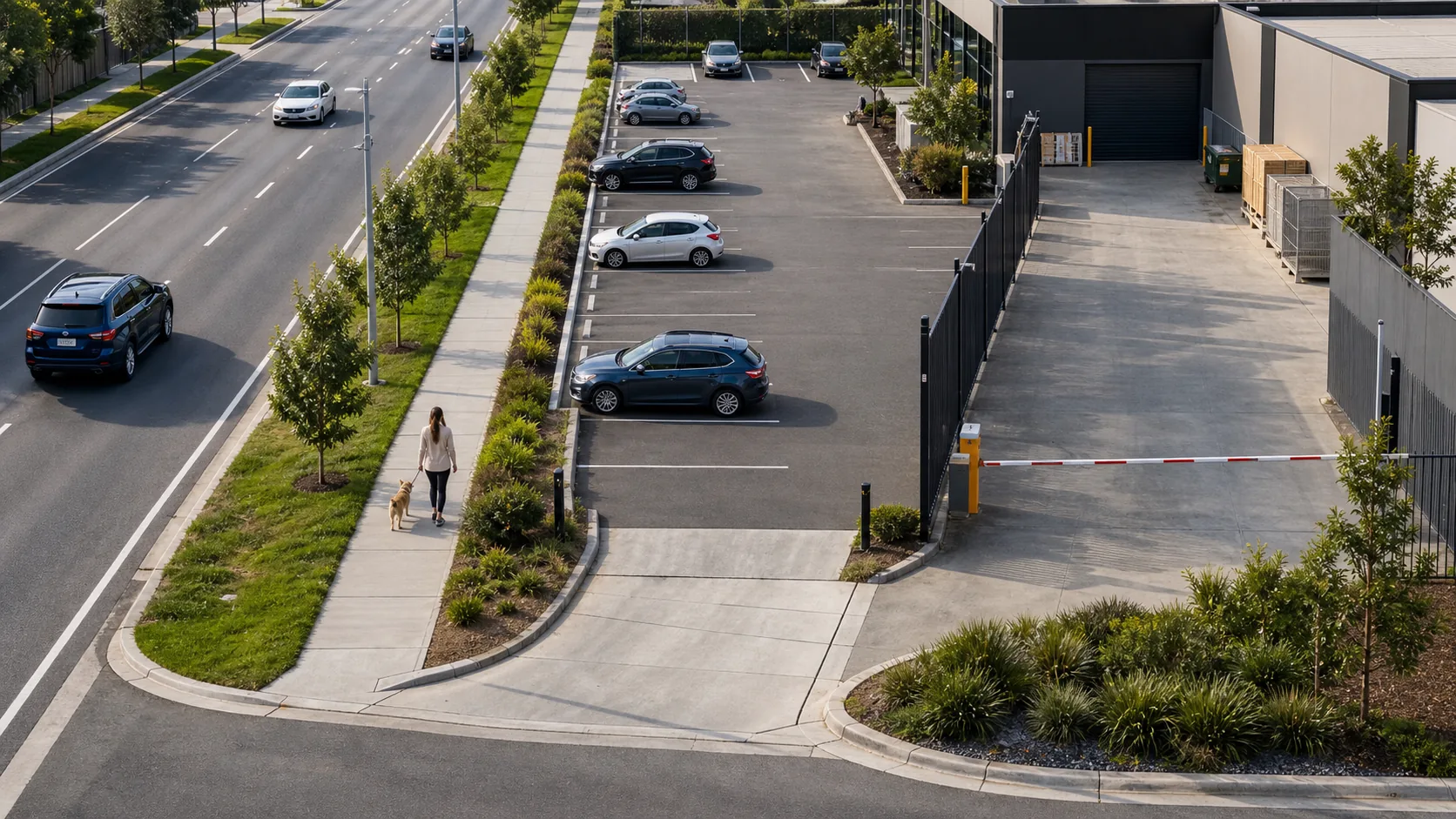
Does every NSW CTP accident have to happen on a road?
No. The correct answer depends first on whether the vehicle was insured and identifiable. Treating every private-property accident as excluded can confuse two different statutory pathways.
Ordinary insured vehicle
A road is not always required
Section 2.3 of the Motor Accident Injuries Act 2017 sets out the ordinary third-party policy. For a vehicle covered by that policy, the insurance generally extends to liability arising from the use or operation of the vehicle in any part of Australia, whether or not the accident occurred on a road.
Private property is therefore not automatically outside CTP cover. A narrower rule applies to a vehicle operating under an unregistered vehicle permit: that policy wording is limited to use or operation on a road. The accident must still satisfy the Act’s motor-accident and causation requirements.
Uninsured or unidentified vehicle
The Nominal Defendant road requirement
Sections 2.29 and 2.30 concern claims involving an uninsured vehicle or a vehicle whose identity cannot be established. Those provisions require the relevant use or operation of the vehicle to have occurred on a road in New South Wales. Section 1.10A applies the Act’s Nominal Defendant liability provisions to statutory benefits as well as damages claims.
For an unidentified vehicle claim, due inquiry and search is a separate requirement. Proving that the accident happened on a road does not by itself prove due inquiry, fault, injury causation or damages eligibility.
Was the vehicle insured?
Can the vehicle be identified?
Is the claim for statutory benefits, damages, or both?
Did the exact location satisfy the statutory definition?
How NSW law defines a road
The Motor Accident Injuries Act adopts the Road Transport Act 2013 definition. A road is an area that is open to or used by the public and is developed for, or has as one of its main uses, the driving or riding of motor vehicles.
Both parts matter. Land does not become a road merely because a vehicle can physically cross it. The area’s design, ordinary purpose, accessibility and actual use need to be examined at the time of the accident.
What is a road-related area?
Section 4(1) of the Road Transport Act extends beyond an ordinary street. It includes:
- an area dividing a road, such as a median
- a footpath or nature strip adjacent to a road
- an area open to the public and designated for cyclists or animals
- an area that is not itself a road but is open to or used by the public for driving, riding or parking vehicles
- the shoulder of a road
- certain other publicly accessible areas declared under the legislation
What does “open to or used by the public” mean?
The definition provides two related ways for an area to qualify. It may be open to the public because members of the community are permitted to enter. Alternatively, it may be used by the public as a matter of fact, even where the landowner did not formally invite that use.
The question is not answered by ownership alone. Nor does an unlocked gate prove public access. The evidence should show who could enter, why they entered, how often the area was used and whether restrictions were real and enforced.
A local community may still be “the public”. The distinction is usually between people using the place as members of the community and a restricted class admitted because they are employees, residents, members or authorised contractors.
Can any member of the public enter?
Is access restricted to customers, employees, residents or contractors?
Are there gates, fences, swipe cards, permits or security checks?
Are restrictions actually enforced?
What is the ordinary purpose of the area?
How frequently do vehicles or pedestrians use it?
Is use isolated, occasional or regular?
What range of people uses the area?
Are there opening hours or periods of closure?
Is the area presented to visitors as available for access or parking?
How the test applies to common accident locations
Labels such as “private property”, “car park” or “driveway” are not conclusions. Different parts of the same site may have different access arrangements.
Customer car parks
A shopping centre, supermarket, medical centre or service-station car park may be a road-related area when members of the public can enter and use it for driving or parking. Entrances, operating hours, parking signs, line markings and invitations to customers may be relevant.
A secured staff-only car park, swipe-card residential garage, locked parking area or restricted loading dock may require a different answer. The exact point of impact within the property must be identified.
Driveways and private access roads
An ordinary residential driveway used by occupants, visitors and delivery drivers is not necessarily open to or used by the public. Those users may be there because of permission connected with one property.
A private access road may have a different character if it links several businesses, operates as a through-road, provides unrestricted access to public facilities or is routinely used by a broad section of the community.
Dirt tracks and reserves
These cases are fact-sensitive. Occasional use by a few people may be insufficient. Regular use by local residents for driving, riding or walking, the way the track has been developed, and whether it connects public places may support a different conclusion.
Signs, barriers, owner enforcement, maps, witness evidence and the history of public use are usually more helpful than simply describing the land as private.
Factories and workplaces
A workplace entrance or public customer car park may differ from a restricted factory floor, depot yard or internal loading area. A vehicle accident at work is not automatically a motor accident on a road.
A separate workers compensation claim may also need to be considered. The schemes can interact, but one should not be assumed to replace or exclude the other without checking the facts.
Court of Appeal authority
Private land and public use: Ryan v Nominal Defendant
Ryan concerned a dirt track on private property near Heddon Greta. There was evidence of regular use by local young people riding bicycles and motorcycles, residents walking, and other community use. Although the landowner had used a gate, dirt mounds and signs, the measures had become largely ineffective.
The majority concluded that the track was used by the public. The case shows why regularity, variety of use, the identity of users, the track’s purpose and the effectiveness of access restrictions matter. Ryan arose under earlier motor accidents legislation, so it remains useful on public use but must be read with the current Act, including its express trespass provisions.
Read the authoritative NSW Caselaw decisionPersonal Injury Commission decision
Restricted workplace land: Wright v NRMA
Wright involved a workplace collision between two uninsured forklifts. The accident did not occur on a road as defined. The Commission held that sections 1.10A and 2.29 applied and that the Nominal Defendant was not liable to pay statutory benefits because the road requirement was not satisfied.
The decision does not mean every workplace accident is excluded. It illustrates why the exact part of the premises and the applicable claim scheme must be identified rather than treating all workplace vehicle incidents alike.
Read the PIC Legal Bulletin summaryCan a trespasser make a Nominal Defendant claim?
Sections 2.29(4) and 2.30(3) contain an express restriction. Where land qualifies because it is a road-related area open to or used by the public for driving, riding or parking vehicles, there is no right of action against the Nominal Defendant if the injured person was a trespasser on the land at the time of the accident.
Evidence of frequent unauthorised use may help describe the character of an area, but it does not automatically overcome that exclusion. Permission to be at the exact accident point is a separate question.
Evidence that can establish a road or road-related area
Location disputes often turn on details that can change quickly. Preserve the scene before gates, signs, barriers, markings or patterns of use change.
A general photograph of the property may not be enough. Mark the precise point of impact because one part of a site may be publicly accessible while another is restricted.
- photos and video of the exact accident point
- photos of every entrance, exit, gate, sign and barrier
- a marked map showing vehicle and injured-person positions
- dashcam, CCTV and preservation requests
- police, ambulance and early medical records
- statements from witnesses and regular users
- opening and closing times
- swipe-card, security or permit arrangements
- parking spaces, arrows and line markings
- council, landowner and property-manager records
- archived street imagery and dated photographs
- public maps, business directions and visitor instructions
- evidence of attempts to prevent unauthorised access
What to do if the insurer disputes the location
Ask the insurer or Nominal Defendant to identify the exact statutory provision, factual finding and accident point relied upon. A useful response addresses the stated reason rather than simply asserting that vehicles were present or the area looked like a road.
Preserve claim and review deadlines while the location evidence is collected. If the unknown vehicle is also disputed, keep due inquiry and search evidence in a separate chronology from the road-related-area evidence.
- Which statutory provision is relied upon?
- What exact point does the insurer say is outside the definition?
- Is public access disputed, actual public use disputed, or both?
- Is trespass alleged?
- What photographs, maps, statements or records did the insurer rely upon?
- Is the decision about statutory benefits, damages, or both?
The bottom line
Whether a place is a road or road-related area cannot always be answered by looking at the property title or asking whether it was privately owned. The practical and legal character of the exact accident point must be established with evidence.
In a borderline Nominal Defendant claim, the location issue may determine whether the claim can proceed before fault, treatment expenses, weekly payments or damages are considered.
What was the exact accident point?
What was the area developed or ordinarily used for?
Could members of the public enter?
Did members of the public actually use it?
Was that use regular or isolated?
Were gates, signs or restrictions effective?
Was the injured person permitted to be there?
Was the vehicle insured and identifiable?
Is the claim against an ordinary insurer or the Nominal Defendant?
Related NSW CTP guides
Use these pages to separate the accident-location issue from vehicle identity, due inquiry, trespass and dispute procedure.
Frequently asked questions
- Is a shopping centre car park a road-related area?
- It may be. A car park that members of the public can enter and use for driving or parking is capable of meeting the definition. The opening hours, access controls and exact accident point still need to be checked.
- Does an accident on private property qualify for a CTP claim?
- Potentially. An ordinary insured vehicle policy generally extends beyond roads, and privately owned land may also qualify as a road or road-related area. The vehicle’s insurance status and the type of claim are critical.
- Is a footpath a road-related area?
- A footpath or nature strip adjacent to a road is expressly included in the Road Transport Act definition of a road-related area.
- Is every public car park a road-related area?
- Not automatically. The evidence must establish that the relevant area was open to or used by the public for driving, riding or parking. A customer car park may differ from a secured staff-only area.
- Can a dirt track be classified as a road?
- Yes, depending on its development and use. Regular public driving or riding, the range of users and the effectiveness of access restrictions may be relevant. The answer is factual and site-specific.
- Does a gate mean the land is not open to the public?
- A secured and enforced gate is strong evidence of restricted access, but the existence of a gate is not conclusive. Its operation, opening hours, effectiveness and the actual pattern of use all matter.
- Can a Nominal Defendant claim be made for an accident on private land?
- Only if the statutory requirements are met. For uninsured or unidentified vehicles, the use or operation must occur on a road in NSW. Because “road” includes a qualifying road-related area, some privately owned places can satisfy that requirement.
Authorities and official sources
- Motor Accident Injuries Act 2017 (NSW), ss 1.10, 1.10A, 2.3, 2.29 and 2.30: Policy scope, application of Nominal Defendant liability to statutory benefits, uninsured and unidentified vehicle provisions, due inquiry and trespass rules.
- Road Transport Act 2013 (NSW), s 4(1): Current statutory definitions of road and road-related area.
- Ryan v Nominal Defendant [2005] NSWCA 59; 62 NSWLR 192: Court of Appeal analysis of public use on a private dirt track under earlier legislation.
- Wright v Insurance Australia Ltd t/as NRMA Insurance [2024] NSWPIC 268: PIC decision concerning uninsured forklifts at a workplace that was not a road.
- Personal Injury Commission, Miscellaneous claims assessment: Current PIC information about miscellaneous claims, internal review and application material.
Has your claim been rejected because of where the accident occurred?
Car parks, private roads, driveways, dirt tracks, reserves and workplaces can raise complex questions about public access, vehicle insurance and Nominal Defendant liability. Before accepting the decision, obtain advice about the exact statutory reason and the evidence needed to answer it.