
Fatigued-driver accidents
Fatigue can contribute to lane drift, delayed braking, missed traffic signals, centre-line crossings and loss of control. The label “fatigue” does not prove fault by itself. The trip history, driving behaviour, rest opportunities, work demands, medical issues and other possible causes must be tested against the contemporaneous evidence.
Preserve evidence of the trip, driving behaviour and rest history early. Statutory personal injury benefits and common law damages are separate claim streams, and a fatigue allegation does not establish either entitlement automatically.
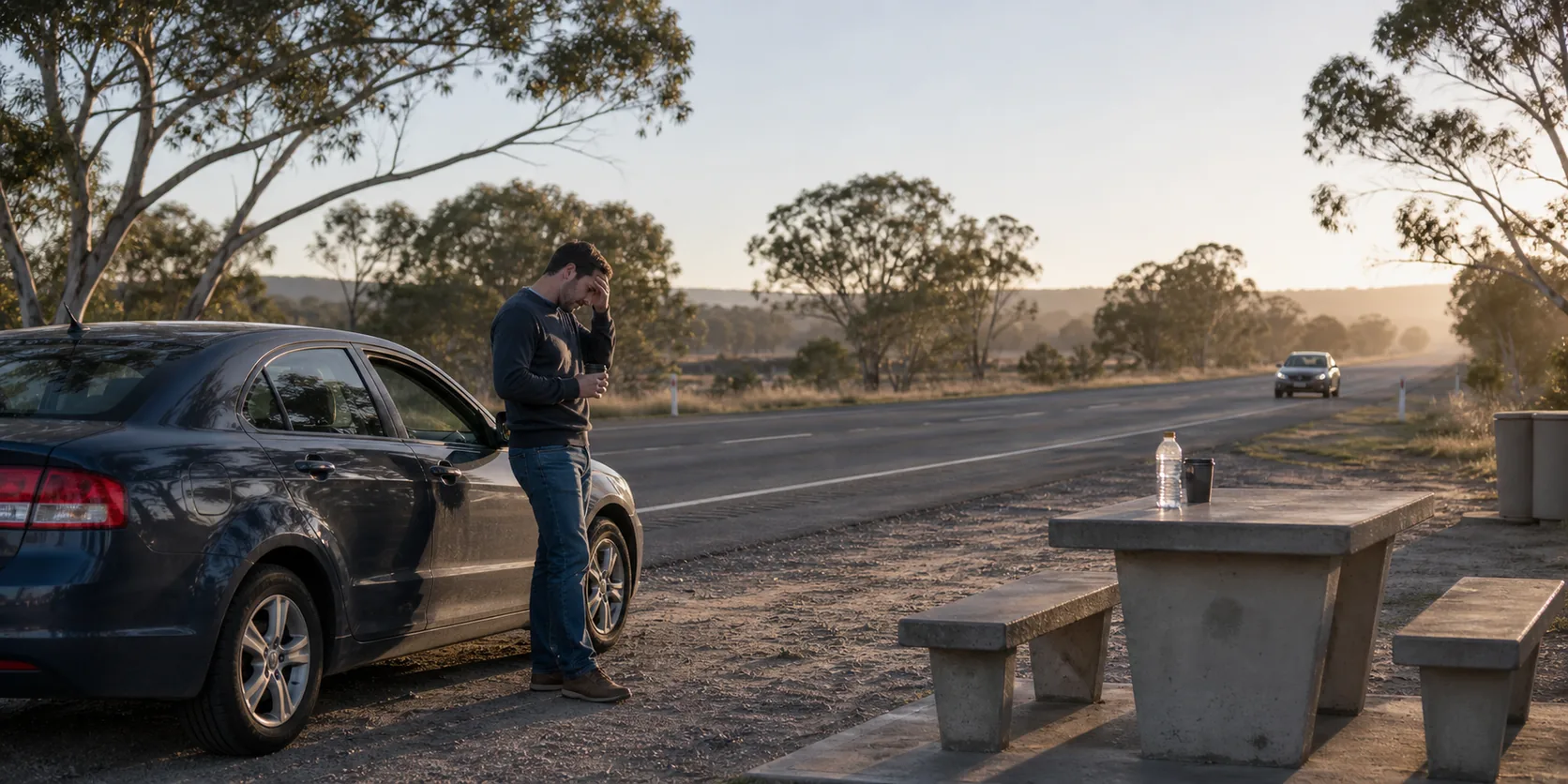
How this accident occurs
- After a long trip, a driver drifts across lane markings or the centre line.
- A driver reacts late to stopped traffic, a red light, roadworks or a queue and brakes too late.
- A driver loses control after an alleged microsleep, especially on a monotonous regional road.
- A shift worker, commercial driver or work-vehicle driver crashes after extended hours or inadequate rest is alleged.
Who may claim
A fatigued-driver crash may injure the fatigued driver, passengers, occupants of another vehicle, motorcycle riders, cyclists or pedestrians. A passenger may have a claim even where the driver of the passenger’s own vehicle is alleged to be at fault. If the accident occurred during work, a separate workers compensation claim may also need to be lodged and coordinated; one scheme does not automatically replace the other.
Realistic examples
- A passenger is injured when the driver falls asleep and runs off a regional road.
- A car drifts into an oncoming lane; dashcam shows no corrective steering before impact.
- A truck or courier vehicle hits queued traffic and work rosters, logbooks or telematics become relevant.
- A driver says fatigue caused the crash, while the insurer says speed, distraction, medication or a sudden medical event was the real cause.
Common injuries
- Neck, back, shoulder and limb injuries from impact or loss of control.
- Head injury, concussion, fracture or internal injury after a higher-speed departure or head-on collision.
- Psychological injury where the accident and subsequent symptoms support a recognised diagnosis and causation.
Statutory benefits
A statutory benefits claim after fatigued-driver accidents can seek treatment and care expenses and, where work capacity is affected, weekly payments. These benefits are decided under the NSW motor accident scheme and insurer decisions can be reviewed or disputed. Statutory benefits do not automatically mean a person also has a damages entitlement.
When common law damages may be possible
A common law damages claim after fatigued-driver accidents is separate from statutory benefits. It may be possible only if the legal requirements are met, including fault, injury classification and other statutory thresholds. The accident type helps identify evidence, but it does not by itself create any entitlement to compensation or damages.
Accident-specific fault issues
- Lane drift, repeated rumble-strip contact, delayed braking and the absence of evasive action may support a fatigue allegation.
- Trip length, sleep history, rest stops, work hours, medication and illness are relevant only to the extent the evidence supports them.
- The insurer may identify a competing cause such as speed, distraction, alcohol, drugs, mechanical failure or a sudden medical episode.
- A passenger contributory-negligence allegation requires evidence about what the passenger knew, the available choices and the circumstances; it should not be assumed.
- Statutory benefits do not automatically establish fault or a separate entitlement to common law damages.
Evidence to preserve
- Dashcam, CCTV, witness accounts, police material and photographs showing lane position, braking or vehicle movement.
- Trip start and finish times, route history, fuel or rest-stop records, phone location data and navigation history where lawfully available.
- Work rosters, timesheets, heavy-vehicle work diaries, delivery records, telematics or onboard video where relevant.
- Medical and pharmacy records if illness, sleep disorder or medication is said to have contributed.
- Early treatment notes linking each claimed injury and symptom to the crash mechanism.
What to do next
- 1
Get medical help and ensure the early record describes the crash mechanism and all physical or psychological symptoms.
- 2
Preserve dashcam, CCTV and witness evidence before it is overwritten or lost.
- 3
Write down the route, trip duration, rest stops, sleep history and any work connection while details are fresh.
- 4
Identify every vehicle and the relevant CTP insurer; keep the police event number and proof of claim lodgement.
- 5
Get advice promptly if fatigue, passenger contributory negligence, work-related travel or an insurer review deadline is raised.
How can a NSW CTP claim be lodged?
A NSW CTP claim is not one single form for every entitlement. Statutory personal injury benefits, common law damages and death-related claims have different approved forms, evidence requirements and legal tests.
- Statutory personal injury benefits are claimed from the relevant CTP insurer using the current approved Application for Personal Injury Benefits or the NSW Government online claim process. A treating medical practitioner certificate and police event details should be provided where available.
- A common law damages claim is separate. It uses the current Application for Common Law Damages and depends on fault, injury classification and statutory requirements. Receiving statutory benefits does not automatically create a damages entitlement.
- A claim may be lodged directly with the insurer through accepted channels such as the NSW Government online claims system, an insurer online claim system, or the written approved form sent by email, personal delivery, facsimile or post where available.
- If a lawyer is instructed, the lawyer can help identify the insurer, prepare the approved forms, gather medical and accident evidence, and lodge the claim or dispute on the client's behalf.
- Where the registration number is known, insurer details can usually be checked through Service NSW registration information or SIRA CTP Assist. If the vehicle is uninsured or unidentified, the claim may need to proceed through the Nominal Defendant pathway.
- For a child or a person unable to make the declaration, the approved forms allow an appropriate parent, guardian, relative, friend or legal personal representative to assist or sign, with their relationship and reason for acting identified.
- If the accident occurred while working, a separate workers compensation claim may also be required and the CTP and workers compensation pathways should be coordinated.
- CTP covers personal injury or death arising from a motor accident. It does not cover ordinary vehicle repairs or property damage, which usually sit with property damage, comprehensive insurance or other recovery pathways.
Time limits, police reporting and late claims
The current NSW scheme has several different timing rules. The safest approach is to report the accident, obtain medical evidence and lodge the correct claim form as early as possible.
- Police reporting: the current SIRA personal injury benefits form says the accident must be reported to police within 28 days. A police event number should be provided, but the form also says a claim can still be submitted while that number is being obtained.
- Statutory benefits: a claim for statutory benefits is generally required within 3 months after the motor accident. A later claim needs a full and satisfactory explanation and must satisfy the Act's late-claim conditions.
- 28-day significance: if a statutory benefits claim is not made within 28 days, weekly payments are generally not backdated for the period before the claim is made unless the Regulation permits it.
- Accidents on or after 1 April 2023: backdated weekly payments may still be considered if the claim is made within 3 months and a full and satisfactory explanation is provided. The Regulation sets factors such as awareness of the right to claim, legal incapacity, illness or injury preventing earlier lodgement, and a 14-day deemed-acceptance rule if the insurer does not reject the explanation.
- Damages: a common law damages claim is generally required within 3 years after the motor accident. A late damages claim requires a full and satisfactory explanation and is assessed separately from any statutory benefits claim.
- Older scheme: accidents before 1 December 2017 were handled under the previous NSW motor accidents scheme and different forms/time limits, including older six-month claim concepts, may apply. This accident type cluster is written for the post-1 December 2017 scheme unless a page says otherwise.
- Review and dispute deadlines can be shorter and decision-specific. Internal review, medical assessment, merit review and PIC steps should be checked as soon as an insurer decision is received.
Common insurer disputes
- The insurer denies fatigue and says speed, distraction, intoxication or another cause better explains the crash.
- The insurer alleges that a passenger knowingly continued with an obviously tired driver and raises contributory negligence.
- The insurer accepts the crash but disputes whether later symptoms, treatment or incapacity were caused by it.
- Weekly payments, treatment, threshold injury classification or damages eligibility may require separate evidence and separate review or PIC processes.
FAQs
Can a passenger claim if the driver of their own vehicle fell asleep?
Potentially. A passenger may claim even where the driver of the vehicle they occupied is alleged to be at fault. The insurer still assesses causation, the injuries and the separate requirements for statutory benefits or damages.
What evidence can show driver fatigue?
Driving behaviour, dashcam, witnesses, trip length, rest stops, work rosters, work diaries, telematics, phone or navigation history, and relevant medical or pharmacy records may assist. No single item automatically proves fatigue.
Can the insurer blame a passenger for travelling with a tired driver?
The insurer may allege contributory negligence, but it needs factual support. What the passenger knew, whether the tiredness was obvious, the choices reasonably available and the surrounding circumstances should all be examined.
Does a fatigue allegation create a common law damages claim?
No. Statutory benefits and common law damages are separate. Damages depend on fault, causation, injury and other legal requirements; receiving statutory benefits does not establish those requirements.
What if the fatigued-driver trip was for work?
A separate workers compensation claim may also be required. The CTP and workers compensation claims may need coordinated medical, income and causation evidence, but one does not automatically exclude the other.