
NSW Personal Injury Commission case note
Marcella v NRMA: fault when leaving a parked position
The Personal Injury Commission found a claimant wholly or mostly at fault after accepting that her vehicle moved from a kerbside parking space into a passing vehicle. The decision shows how early histories, vehicle damage, photographs, expert assumptions and the separate statutory-benefits test can shape a parked-vehicle fault dispute.
Reviewed by Herman Chan of Stephen Young Lawyers.
Decision in brief
What did Marcella v NRMA decide?
The Member rejected the claimant's case that her Mini remained stationary while the insured vehicle passed. The contemporaneous histories, photographs and damage pattern supported a finding that she was pulling out from the parking space and struck the rear passenger side of the passing vehicle. No speeding, unsafe lane position or other culpability by the insured driver was proved. The claimant was therefore assessed as 100% contributorily negligent and wholly or mostly at fault for the purposes of sections 3.11 and 3.28. This did not finally determine her separate damages claim and does not make every driver leaving a parking space automatically at fault.
Case at a glance
- Full case name
- Marcella v Insurance Australia Limited t/as NRMA Insurance
- Neutral citation
- [2026] NSWPIC 437
- Division
- Personal Injury Commission of NSW, Motor Accidents Division
- Decision date
- 28 July 2026
- Decision-maker
- Member Belinda Cassidy
- Issue
- Whether the claimant was wholly or mostly at fault for the purposes of ongoing weekly payments and treatment-and-care statutory benefits.
- Full decision
- AustLII
Background and claim history
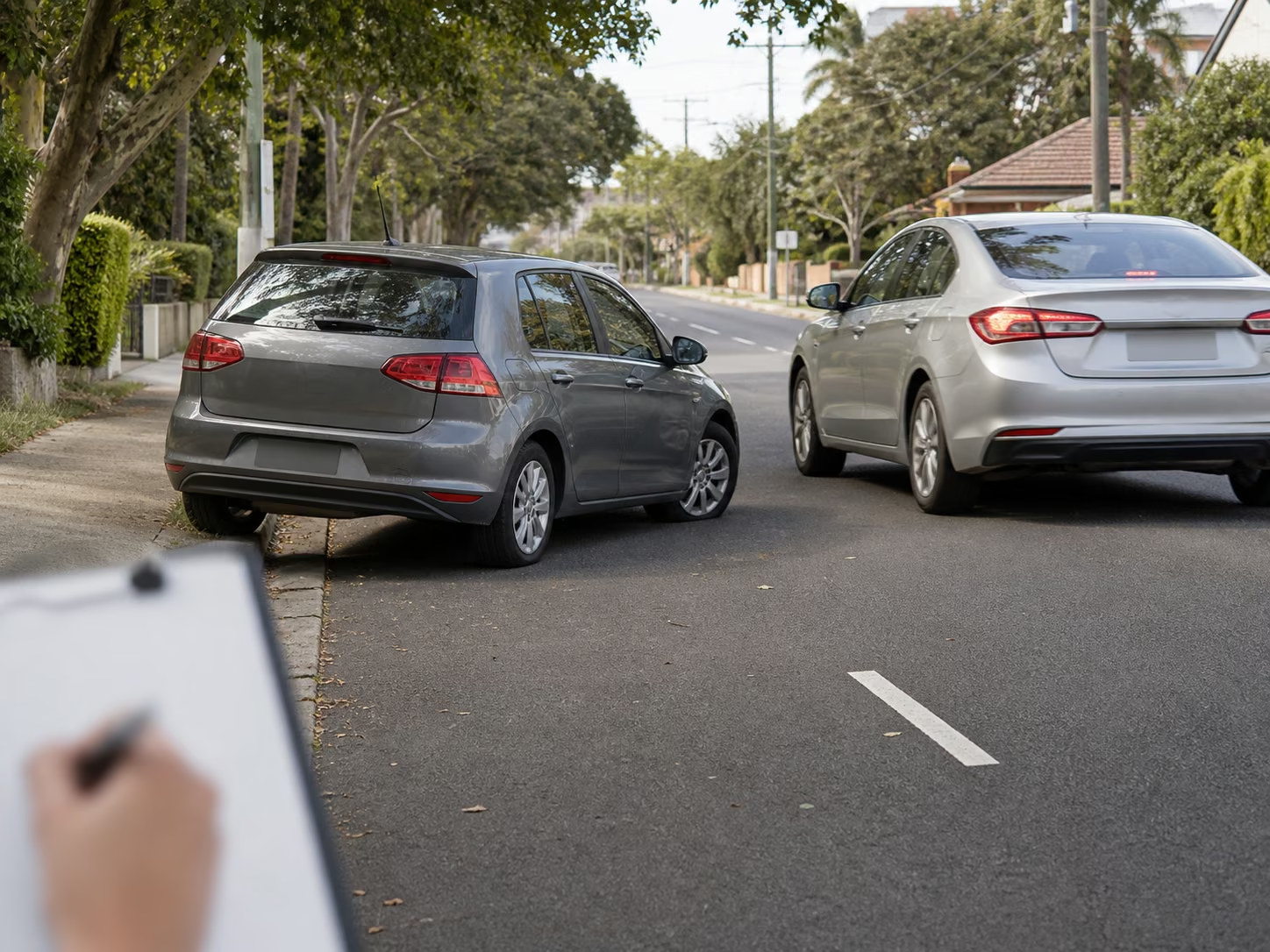
On 1 May 2024, Regina Angie Marcella was involved in a collision on O'Connell Street at Monterey in Sydney. Her Mini had been parked outside a florist. The other vehicle, a Mitsubishi driven by Mr Gordon, was travelling along the street when contact occurred between the front driver's side of the Mini and the rear passenger side of the Mitsubishi.
Ms Marcella lodged a statutory benefits claim on 3 May 2024. NRMA accepted the claim on 23 May 2024. On 14 January 2025, however, the insurer issued a further liability notice denying ongoing statutory benefits on the basis that she was wholly or mostly at fault.
An internal-review request was made on 14 August 2025. NRMA refused to undertake the review because it was late, and the fault dispute then proceeded to the Personal Injury Commission. The Commission was asked to determine the weekly-payment and treatment-and-care issues declared under Schedule 2 of the Motor Accident Injuries Act 2017.
Ms Marcella had also made a separate common law damages claim. NRMA denied that its insured driver was at fault. That damages claim formed part of the procedural background but was not the claim finally determined by this PIC certificate.
The competing accident accounts
The claimant's initial claim form described her as stationary and preparing to drive away from the parallel parking space. A later statement said the engine was running, the right indicator was activated and she had checked her surroundings, but the vehicle remained stationary. At the assessment conference, she could not remember whether the car had started moving before impact.
The insured driver said he was travelling along O'Connell Street and that the Mini moved out as he passed it, striking the rear passenger side of his vehicle. He did not see the Mini begin moving because the point of contact was behind his driving position.
The early records were important. Ambulance officers recorded a history of the claimant pulling out, while the police material described her as beginning to pull out. The Member did not treat those entries in isolation, but considered them with the claimant's memory, the vehicle positions, the physical damage and the expert evidence.
Importantly, the Member did not make an adverse reliability finding merely because Ms Marcella had a memory gap, was nervous or may not have understood some questions. The reasons expressly recognised those matters. The movement finding came from the combined evidence rather than a general attack on her credibility.
Photographs, early records and expert evidence
Both parties relied on accident-reconstruction experts. The insurer's expert, Dr McIntosh, considered that the damage was consistent with the Mini moving sideways from the parking space and striking the Mitsubishi as it travelled straight ahead. He found no objective basis for excessive speed and considered there was nothing the insured driver could reasonably have done to avoid the impact.
The claimant's expert, Mr Johnston, considered the Mini was stationary or moving only minimally and relied substantially on a visible fluid trail to place the impact within the parking area. He expressed the view that the Mitsubishi was travelling too close to the parked vehicles.
The Member preferred Dr McIntosh's damage analysis. The fluid-trail opinion depended on assumptions about where the Mini came to rest and where impact occurred. Those assumptions did not sufficiently account for gaps in the photographic set, the vehicle's possible post-impact rotation, the fact that the Mini was later moved and re-parked, other debris, and the insured driver's evidence about the Mitsubishi's path after impact.
The decision is a practical reminder that expert labels do not replace the underlying evidence. A reconstruction report should state which photographs were available, whether either vehicle moved after impact, what physical measurements were taken, and which facts are assumed rather than proved.
What the PIC found
The Member was not satisfied that the Mini remained stationary. The early histories, angled post-accident position and damage to the Mini's front driver side and the Mitsubishi's rear passenger side supported the conclusion that the claimant was pulling out from the parking space when contact occurred.
The claimant alleged that the insured vehicle was speeding. She had not seen it before impact and therefore could not estimate its speed. Neither expert identified objective evidence of excessive speed. The Member found that the insured driver was not travelling above the applicable speed limit.
The allegation that the Mitsubishi travelled too close to the parked cars was also rejected. The fluid-trail reasoning was not accepted, the insured driver denied travelling too close, and the lack of damage to either wing mirror supported the insurer's reconstruction evidence.
The claimant had failed to keep a proper lookout and moved into the lane when it was unsafe. The passing vehicle was there to be seen. The Member found no culpable act or omission by the insured driver and assessed the claimant's contributory negligence at 100%.
The wholly-or-mostly-at-fault test
Section 3.1 of the Act makes initial statutory benefits available without requiring an injured person to prove another driver's fault. Different consequences arise after 52 weeks. Under sections 3.11 and 3.28, weekly payments and treatment-and-care benefits can cease where the motor accident was caused wholly or mostly by the injured person's fault. Section 3.28 provides that a person is mostly at fault where their contributory negligence in relation to the accident is greater than 61%.
The Member applied the approach explained by the Supreme Court in AAI Limited t/as GIO v Evic [2024] NSWSC 1272. The expression "wholly or mostly at fault" is approached through contributory negligence in relation to the accident. The decision-maker considers the reasonable-person standard, whether the claimant departed from it, whether the insured driver also departed from the required standard, and any just and equitable apportionment of responsibility.
Marcella therefore did not turn simply on the fact that the claimant was leaving a parking space or may have breached a road rule. The Member made findings about both drivers' conduct and then compared their culpability. Because no culpability was found against the insured driver, the claimant was held wholly or mostly at fault.
Effect on statutory benefits and the separate damages claim
The certificate determined the fault questions that affected ongoing statutory benefits under sections 3.11 and 3.28. It did not retrospectively convert the initial fault-independent benefits claim into a damages claim, and it did not suggest that the insurer's original acceptance of statutory benefits was legally mistaken.
A common law damages claim is separate. It requires its own liability, causation, loss, procedural and time-limit analysis. The reasons recorded that NRMA had denied fault in the separate damages claim, but the Member did not make a final damages assessment or determine compensation value in this statutory-benefits dispute.
The distinction matters when reading a PIC certificate. A finding can have immediate consequences for weekly payments or treatment expenses without resolving every issue that might arise in a damages claim. The exact decision and the order sought should be identified before deciding what review or further evidence is required.
The Member also permitted both sides to recover costs beyond the regulated amounts because the matter involved an assessment conference, counsel, competing experts and substantial production work. That exceptional, case-specific order should not be read as automatic recovery of all legal costs in another PIC matter.
What the decision does not establish
Marcella does not establish that a driver moving from a parking space is always wholly or mostly at fault. A passing driver may be speeding, distracted, crossing into the parking lane, failing to react to a visible hazard or otherwise culpable. Dashcam, CCTV, witnesses and a sound reconstruction may produce a materially different result.
The decision does not make early medical or police histories infallible. Such records may contain shorthand, assumptions or misunderstandings. Their weight depends on who provided the history, when it was recorded and how it fits with the objective evidence. Here, the histories were considered with the photographs and damage rather than used alone.
Nor does the decision mean fluid trails are never useful. The problem was the reliability of the particular assumptions and incomplete evidence used to interpret this trail. Physical traces can be valuable where the source, timing, vehicle movements and full photographic context are established.
Finally, this is a decision of one PIC Member on its own facts. It is useful for understanding the statutory approach and evidence analysis, but it is not a substitute for applying the current Act and evidence to another accident.
Practical evidence lessons
A parked-position fault dispute should be prepared as an evidence problem, not reduced to competing assertions that one vehicle was stationary and the other was speeding. The most useful file usually includes:
- the insurer liability notice and the precise reasons given for alleging wholly or mostly at fault
- the statutory benefits claim form and every early description given to police, ambulance officers and property insurers
- wide and close photographs showing the road, parking lane, vehicle positions, damage and debris
- dashcam, CCTV and independent witness evidence obtained before it is lost
- repair assessments and photographs showing the direction and height of damage to both vehicles
- a plan marking the point of impact, resting positions and any movement of either vehicle after impact
- an explanation of who moved a vehicle after the collision and why, because later movement can affect reconstruction evidence
- expert reports that identify every factual assumption, photograph and measurement used
- the internal-review request, insurer response and any PIC directions or filing correspondence
If memory is incomplete, say so accurately. Do not try to fill a gap by guessing. Instead, identify which objective records can answer the movement, position, speed and avoidability questions. If an expert is instructed, the brief should include the complete photographic set and any evidence about post-impact movement.
When an insurer issues an adverse liability notice, separate the issues: the accident facts, the legal test, the benefits affected, the internal-review history and any separate damages claim. Review and PIC requirements can depend on the exact decision and dates, so the letter should be checked promptly.
Case analysis
Key takeaways from Marcella v NRMA
- 1.A vehicle being close to a parked position does not, by itself, establish that it was stationary at impact.
- 2.Early ambulance, police and claim descriptions can become important when later recollection is incomplete.
- 3.Damage patterns may help test whether a vehicle was moving sideways into passing traffic or was struck while stationary.
- 4.An accident-reconstruction opinion is only as reliable as its photographs, measurements and factual assumptions.
- 5.An allegation of speeding needs an evidentiary foundation; assertion alone may not be enough.
- 6.The initial statutory-benefits scheme is fault-independent, but sections 3.11 and 3.28 can end benefits after 52 weeks where the claimant was wholly or mostly at fault.
- 7.A statutory-benefits fault determination does not automatically determine a separate common law damages claim.
Frequently asked questions
- Is a driver leaving a parked position always at fault?
- No. Marcella was decided on detailed evidence about vehicle movement, early histories, photographs, damage patterns, speed and lane position. Another case may involve a speeding or distracted passing driver, poor visibility, a dooring event, a vehicle pushed from behind or reliable footage showing the parked vehicle did not move.
- Does using an indicator prove it was safe to pull out?
- No. An indicator communicates an intention; it does not give priority. The Member accepted that Ms Marcella said she indicated, but found that the passing vehicle was there to be seen and that moving into the lane was unsafe.
- Why did the ambulance and police histories matter?
- They recorded descriptions that the claimant was pulling out or beginning to pull out. Those early records were considered with the claimant’s later evidence that she could not remember whether the vehicle had started moving. They were not treated as an automatic rule, but they formed part of the overall fact-finding exercise.
- Will an accident reconstruction report decide the case?
- Not by itself. The decision-maker evaluates the expert’s assumptions, source material and reasoning. In Marcella, the Member preferred one damage-pattern analysis and rejected the competing fluid-trail opinion because important photographs and post-impact vehicle movements had not been adequately accounted for.
- What does wholly or mostly at fault mean for statutory benefits?
- Under the current Act, a person is mostly at fault where their contributory negligence in relation to the accident is greater than 61%. Sections 3.11 and 3.28 can end weekly payments and treatment-and-care benefits after 52 weeks for a person found wholly or mostly at fault. The exact effect should be checked against the insurer decision and current law.
- Did Marcella finally decide the common law damages claim?
- No. The reasons record that a damages claim had been made and denied, but the PIC application determined the statutory-benefits fault issues under sections 3.11 and 3.28. Damages liability, causation and loss remained a separate process.
- What if the insurer refuses an internal review because the request was late?
- Do not assume that the dispute is over. Keep the decision, the review request, the refusal and the explanation for delay, then obtain advice about the current PIC requirements and available process. The correct step depends on the decision type, dates, statutory provisions and procedural history.
Related NSW CTP guides
Official sources
Reviewing a fault decision
Has the insurer said you were wholly or mostly at fault?
NSW CTP Claim is a specialised service of Stephen Young Lawyers. We can review the liability notice, accident descriptions, photographs, damage evidence, expert reports and the available internal-review or PIC process. Advice depends on the exact decision, evidence and any applicable time limit. No outcome is guaranteed.
General information: This case note is not legal advice. Fault, contributory negligence, statutory benefits, internal review, PIC procedure and damages depend on the current law, the insurer decision and the evidence in the individual claim. Time limits may apply.