
Lifetime Care and Support Scheme (icare): NSW CTP for Severe Injuries
The Lifetime Care and Support Scheme is a NSW Government program that covers treatment, rehabilitation, and care for severe motor accident injuries, administered by icare. For severe-injury clients, it is a parallel care pathway—not a substitute for your CTP insurer claim. You still need to manage evidence, evidence timing, and entitlements across both tracks. General information only.
Quick answer
The Lifetime Care and Support Scheme is a NSW Government program that covers treatment, rehabilitation, and care for severe motor accident injuries, administered by icare. For severe-injury clients, it is a parallel care pathway—not a substitute for your CTP insurer claim. You still need to manage evidence, evidence timing, and entitlements across both tracks. General information only.
Why this guide is structured this way
This page is written to help NSW CTP claimants understand deadlines, evidence, insurer decisions, and dispute pathways in plain language without overstating outcomes.
General information only. Your position depends on your facts, evidence, insurer response, and applicable time limits.
Top questions answered
What is the Lifetime Care and Support Scheme?
The Lifetime Care and Support Scheme (run by icare) pays for the treatment, rehabilitation, and care of people severely injured in motor accidents in NSW, regardless of who was at fault.
Who is eligible for Lifetime Care?
Eligibility is limited to those with severe injuries, including traumatic brain injury, spinal cord injury, amputations (or equivalent impairment), severe burns, or permanent blindness.
What is the difference between Interim and Lifetime participation?
If eligible, you are first accepted as an “interim participant” for two years. During this time, your needs are assessed. After two years, you may be eligible to become a “lifetime participant”.
Eligibility and Severity Criteria
Eligibility for the Scheme is based on meeting specific severity thresholds for injuries sustained in a motor accident. These criteria are defined in the Lifetime Care and Support Guidelines. Qualifying injuries include:
- Traumatic Brain Injury (TBI): assessed via the Westmead PTA scale or Glasgow Comatose Scale (GCS), often requiring proof of permanent functional impairment.
- Spinal Cord Injury: resulting in permanent neurological deficit.
- Amputations: or the equivalent permanent loss of use of a limb.
- Severe Burns: meeting specific surface area or full-thickness thresholds.
- Permanent Blindness: as defined by clinical visual acuity standards.
Participation is available regardless of who was at fault. However, fault still impacts your broader CTP damages claim, which sits outside of icare.
Reasonable and Necessary Care Support
The Scheme provides funding for "reasonable and necessary" services directly related to the accident injuries. This typically includes:
- Medical & Pharmaceutical: hospitalisation, specialist consultations, and medications.
- Rehabilitation: physiotherapy, occupational therapy, and speech pathology.
- Attendant Care: support with personal care, domestic tasks, and community participation.
- Assistive Technology: wheelchairs, mobility aids, and specialised communication equipment.
- Modifications: structural changes to your home or vehicle to ensure accessibility and safety.
- Vocational Support: assistance with return-to-work or return-to-study pathways.
It is important to note that icare does not provide "lump sum" funding for these items; they are funded as they are needed throughout your participation.
Interim vs. Lifetime Participation
Participation in the Scheme typically occurs in two phases:
- Interim Participant: If eligible, you are accepted into the Scheme for an initial period of two years. During this time, icare pays for your reasonable and necessary care and assessments are ongoing.
- Lifetime Participant: After the two-year interim period, a further assessment is conducted to determine if you meet the criteria for lifetime participation.
That review point matters. Severe-injury claimants often assume the Lifetime Care acceptance letter answers every future funding or compensation question. In practice, you still need to preserve treating evidence, functional evidence, and insurer correspondence so the Lifetime Care pathway and the separate CTP pathway stay aligned.
Interaction with your CTP claim (Crucial)
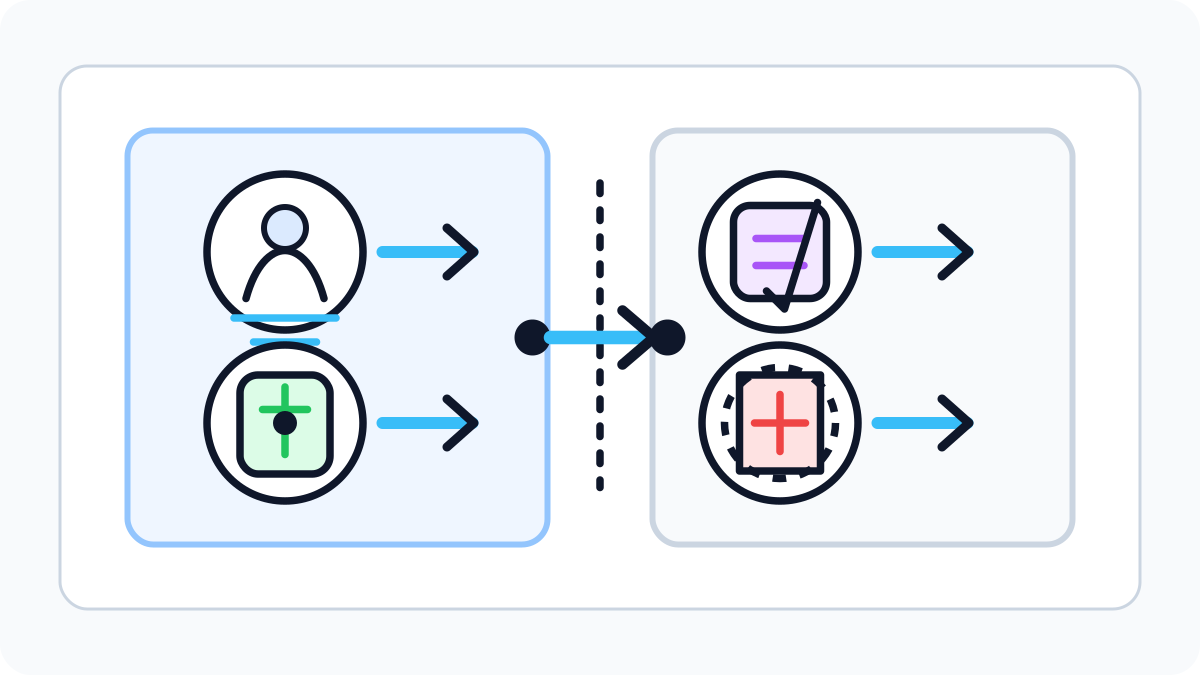
A common misconception is that if you are in Lifetime Care, your "claim" is finished. This is incorrect. While icare (Lifetime Care) takes over the medical and care components of your claim, you still have a separate CTP claim with the CTP insurer for:
- Weekly income support payments
- Common law damages (economic loss and, in serious cases, pain and suffering)
It is vital that these two processes are managed correctly to ensure you don’t lose access to lump sum entitlements.
That usually means separating:
- Lifetime Care service approvals for treatment, attendant care, equipment, and home or vehicle modifications
- CTP insurer decisions about weekly benefits, work capacity, treatment disputes, fault issues, WPI, and damages access
People get into trouble when they assume an icare care decision automatically fixes an insurer dispute about earning capacity, treatment refusal, or longer-term damages rights. It often does not.
What usually makes a stronger Lifetime Care + CTP file
Where severe injury matters become complex, the strongest files usually preserve both care evidence and dispute-pathway evidence from the start.
- Clear diagnosis and severity records: hospital records, imaging, operative reports, rehab summaries, and specialist opinions should consistently describe the qualifying injury and its functional effect.
- Functional and support evidence: attendant-care needs, equipment needs, home-access issues, transport restrictions, and day-to-day supervision requirements often matter just as much as raw diagnosis labels.
- Work and earning material: if weekly benefits or future earning capacity are affected, keep wage records, tax records, certificates of capacity, and return-to-work documents separate from care approvals.
- Decision chronology: keep the Lifetime Care acceptance, review letters, insurer decisions, internal review requests, and any PIC-related material in date order.
- Threshold and damages planning: severe injuries often raise later questions about WPI threshold issues, non-economic loss, and broader common law damages. Those issues should be planned early, not after years of treatment.
Common problems that weaken severe-injury claims
- Assuming Lifetime Care replaces the whole claim: it does not replace weekly-benefit, dispute, and damages issues with the CTP insurer.
- Mixing care and compensation issues together: care approvals, work-capacity disputes, treatment denials, WPI disputes, and damages access often sit on different tracks and need different evidence.
- Not preserving insurer review rights: if the insurer stops payments or disputes treatment, internal review and PIC timelines still matter even in catastrophic injury matters.
- Weak functional evidence: severe diagnosis alone is not always enough. Daily support needs, supervision issues, mobility limits, and work restrictions should be documented properly.
- Leaving damages strategy too late: catastrophic injury files often need early planning around future loss, rehabilitation, and long-term earning consequences.
What if the insurer still disputes benefits or treatment?
Even where a claimant is in Lifetime Care, disputes can still arise about weekly benefits, work capacity, treatment causation, threshold injury issues, or the correct pathway for a medical dispute. Those matters may still require:
- internal review of an insurer decision
- careful separation between merit review and medical assessment pathways
- preparation for the Personal Injury Commission if the matter escalates
That is one reason severe-injury files need active coordination rather than assuming the Scheme itself solves every downstream disagreement.
Evidence and dispute points that usually matter most
Where a severe-injury file sits across both Lifetime Care and the ordinary CTP insurer pathway, the practical dispute points are often less obvious than on a standard claim. The issues that usually matter most include:
- qualification and severity proof: imaging, neurosurgical or orthopaedic records, rehabilitation notes, and functional assessments should support both Lifetime Care eligibility and the ongoing description of the injury
- treatment-causation alignment: if the insurer argues that some later treatment, care, or surgery is unrelated, the chronology from accident to intervention needs to be coherent
- work-capacity separation: attendance-care needs and rehabilitation supports do not automatically answer disputes about certificates, earning capacity, or stopped weekly payments
- IME and assessor response planning: catastrophic injury claimants are still exposed to insurer medical opinions on threshold, causation, treatment, and WPI issues, so adverse reasoning should be answered directly rather than ignored
- future-loss and damages readiness: longer-term needs around work, care, assistive technology, home modifications, and rehabilitation often interact with later damages strategy, including WPI and non-economic loss issues
The strongest severe-injury files usually keep the Lifetime Care records and the insurer dispute records coordinated, but not confused. That makes later review or PIC escalation far easier.
Common mistakes when people rely on Lifetime Care alone
- assuming service approval equals compensation approval: an icare approval for care, equipment, or rehab does not automatically resolve separate insurer disputes about earnings, treatment, threshold status, or damages
- under-documenting functional decline: severe injuries can be obvious, but the practical evidence about supervision, mobility, self-care, transport, and work restrictions still matters
- letting review deadlines drift: the existence of catastrophic injury support can create a false sense that insurer disputes can wait indefinitely
- failing to separate pathway questions: care eligibility, treatment funding, weekly benefits, WPI, and settlement readiness often require different evidence and sometimes different decision-makers
- treating the file as medical only: severe-injury claims also need wage, tax, employer, and vocational records where future earning loss is significant
These mistakes can weaken both immediate entitlements and the long-term value of the claim.
First 14 days after Lifetime Care entry: dispute-proofing checklist
The first two weeks after a severe-injury file moves into the Scheme are often when avoidable compensation mistakes happen. A practical checklist is:
- confirm participation stage in writing: lock in whether the file is interim-only or moving toward lifetime participation, and preserve all acceptance/review correspondence
- split records into two tracks: maintain a dedicated Lifetime Care services file and a separate insurer-dispute file (weekly benefits, capacity, treatment disputes, threshold and WPI)
- freeze key deadlines: if insurer decisions are adverse, diarise internal review and escalation windows immediately rather than assuming Scheme support pauses those timelines
- stabilise functional evidence: update treating notes on mobility, supervision needs, ADLs, transport and work restrictions so functional impact is evidenced, not implied
- map forward damages strategy: identify what evidence is still needed for future earning loss, WPI threshold, and non-economic loss access
This short window is where a severe file either stays coordinated across both pathways or drifts into fragmented decision-making that is hard to fix later.
Why you should contact us immediately
If your claim is being transferred—or is eligible to be transferred—to the Lifetime Care and Support Scheme, you should contact us immediately to discuss your situation.
Managing the transition to icare while simultaneously pursuing a common law damages claim against a CTP insurer requires careful legal strategy. We can ensure that your long-term interests are protected across both schemes.
Frequently asked questions
- What is the Lifetime Care and Support Scheme?
- The Lifetime Care and Support Scheme (run by icare) pays for the treatment, rehabilitation, and care of people severely injured in motor accidents in NSW, regardless of who was at fault.
- Who is eligible for Lifetime Care?
- Eligibility is limited to those with severe injuries, including traumatic brain injury, spinal cord injury, amputations (or equivalent impairment), severe burns, or permanent blindness.
- What is the difference between Interim and Lifetime participation?
- If eligible, you are first accepted as an “interim participant” for two years. During this time, your needs are assessed. After two years, you may be eligible to become a “lifetime participant”.
- Do I still have a CTP claim if I am in Lifetime Care?
- Yes. While Lifetime Care (icare) handles your medical and care expenses, you still have a CTP claim with the motor insurer for other entitlements, such as weekly income support and potential common law damages for economic loss.
- Can the same evidence support both Lifetime Care and my insurer dispute?
- Yes, but only if kept separately. Keep treatment and functional evidence in both structures, then split them by issue: care service approvals vs insurer dispute issues such as weekly payments, work capacity, treatment refusals, and damages thresholds.
- If icare approves treatment, can the insurer still challenge weekly payments or work capacity?
- Yes. A treatment or care approval does not automatically settle work-capacity or weekly-payment disputes. Keep a separate insurer timeline with certificates, wage evidence, and written responses to adverse decisions so you can protect review rights on time.