
Side-impact and T-bone accidents
Side-impact accidents usually require careful analysis of intersection layout, traffic lights, stop or give-way obligations, turn direction and the angle of impact.
The angle of impact is important, but it must be matched with signal timing, witness accounts, road markings and vehicle damage.
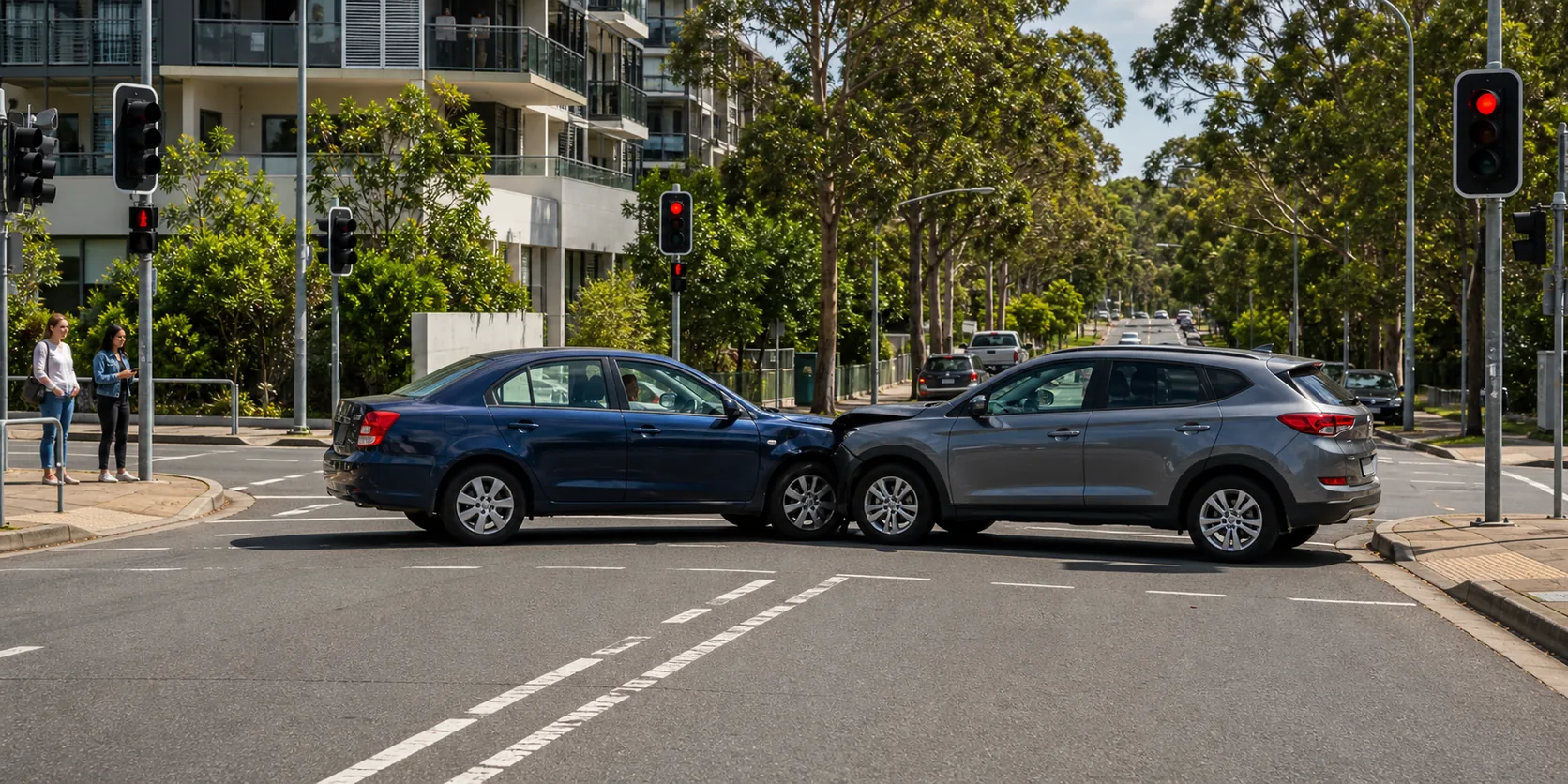
How this accident occurs
- One vehicle enters or crosses the path of another at an intersection.
- A driver turns across traffic or proceeds when another vehicle has priority.
- The side of a vehicle is struck, which can cause different injuries from a front or rear impact.
Who may claim
People injured in side-impact and t-bone accidents may include drivers, passengers, motorcycle riders, cyclists, pedestrians and sometimes people in nearby vehicles. An at-fault driver may still have statutory benefits for a period, but fault can affect benefit duration and any later damages pathway.
Realistic examples
- A vehicle turns right across oncoming traffic.
- A car enters from a side road and strikes the side of a through vehicle.
- Two vehicles dispute who had the green light or priority.
Common injuries
- Rib, chest, shoulder, hip, pelvis and knee injuries.
- Neck, back, head injury or concussion symptoms.
- Psychological injury, especially where the impact was sudden and from the side.
Statutory benefits
A statutory benefits claim after side-impact and t-bone accidents can seek treatment and care expenses and, where work capacity is affected, weekly payments. These benefits are decided under the NSW motor accident scheme and insurer decisions can be reviewed or disputed. Statutory benefits do not automatically mean a person also has a damages entitlement.
When common law damages may be possible
A common law damages claim after side-impact and t-bone accidents is separate from statutory benefits. It may be possible only if the legal requirements are met, including fault, injury classification and other statutory thresholds. The accident type helps identify evidence, but it does not by itself create any entitlement to compensation or damages.
Accident-specific fault issues
- Who had priority under the road layout and signals.
- Whether a vehicle failed to stop, give way or keep a proper lookout.
- Whether both drivers entered on changing lights or moved too quickly.
- Whether blocked views, parked cars or road design affected visibility.
Evidence to preserve
- Traffic-light phasing, CCTV and dashcam.
- Photos of lane markings, stop lines, sight lines and final resting positions.
- Repair photos showing side intrusion, impact height and angle.
What to do next
- 1
Get medical treatment and report all physical and psychological symptoms early.
- 2
Record the registration, driver details, police event number and insurer information.
- 3
Preserve dashcam, CCTV, witness details, scene photos and repair evidence before they disappear.
- 4
Lodge the statutory benefits claim with the correct CTP insurer and keep copies of all forms and certificates.
- 5
Seek legal advice if fault, treatment, weekly payments, injury classification or damages are disputed.
How can a NSW CTP claim be lodged?
A NSW CTP claim is not one single form for every entitlement. Statutory personal injury benefits, common law damages and death-related claims have different approved forms, evidence requirements and legal tests.
- Statutory personal injury benefits are claimed from the relevant CTP insurer using the current approved Application for Personal Injury Benefits or the NSW Government online claim process. A treating medical practitioner certificate and police event details should be provided where available.
- A common law damages claim is separate. It uses the current Application for Common Law Damages and depends on fault, injury classification and statutory requirements. Receiving statutory benefits does not automatically create a damages entitlement.
- A claim may be lodged directly with the insurer through accepted channels such as the NSW Government online claims system, an insurer online claim system, or the written approved form sent by email, personal delivery, facsimile or post where available.
- If a lawyer is instructed, the lawyer can help identify the insurer, prepare the approved forms, gather medical and accident evidence, and lodge the claim or dispute on the client's behalf.
- Where the registration number is known, insurer details can usually be checked through Service NSW registration information or SIRA CTP Assist. If the vehicle is uninsured or unidentified, the claim may need to proceed through the Nominal Defendant pathway.
- For a child or a person unable to make the declaration, the approved forms allow an appropriate parent, guardian, relative, friend or legal personal representative to assist or sign, with their relationship and reason for acting identified.
- If the accident occurred while working, a separate workers compensation claim may also be required and the CTP and workers compensation pathways should be coordinated.
- CTP covers personal injury or death arising from a motor accident. It does not cover ordinary vehicle repairs or property damage, which usually sit with property damage, comprehensive insurance or other recovery pathways.
Time limits, police reporting and late claims
The current NSW scheme has several different timing rules. The safest approach is to report the accident, obtain medical evidence and lodge the correct claim form as early as possible.
- Police reporting: the current SIRA personal injury benefits form says the accident must be reported to police within 28 days. A police event number should be provided, but the form also says a claim can still be submitted while that number is being obtained.
- Statutory benefits: a claim for statutory benefits is generally required within 3 months after the motor accident. A later claim needs a full and satisfactory explanation and must satisfy the Act's late-claim conditions.
- 28-day significance: if a statutory benefits claim is not made within 28 days, weekly payments are generally not backdated for the period before the claim is made unless the Regulation permits it.
- Accidents on or after 1 April 2023: backdated weekly payments may still be considered if the claim is made within 3 months and a full and satisfactory explanation is provided. The Regulation sets factors such as awareness of the right to claim, legal incapacity, illness or injury preventing earlier lodgement, and a 14-day deemed-acceptance rule if the insurer does not reject the explanation.
- Damages: a common law damages claim is generally required within 3 years after the motor accident. A late damages claim requires a full and satisfactory explanation and is assessed separately from any statutory benefits claim.
- Older scheme: accidents before 1 December 2017 were handled under the previous NSW motor accidents scheme and different forms/time limits, including older six-month claim concepts, may apply. This accident type cluster is written for the post-1 December 2017 scheme unless a page says otherwise.
- Review and dispute deadlines can be shorter and decision-specific. Internal review, medical assessment, merit review and PIC steps should be checked as soon as an insurer decision is received.
Common insurer disputes
- The insurer says the claimant entered against the light or failed to give way.
- The insurer disputes whether the injury mechanism matches the side impact.
- Treatment is refused as not reasonable or unrelated.
- Contributory negligence is alleged due to speed or lookout.
FAQs
Can I make a NSW CTP claim after side-impact and t-bone accidents?
You may be able to claim if you were injured in a motor accident and the NSW CTP scheme applies. The claim still needs insurer identification, medical evidence and attention to time limits.
Who is at fault in side-impact and t-bone accidents?
Fault depends on the evidence. For this accident type, the key issues are intersection priority, side impact angle and traffic lights. Do not assume fault from the accident label alone.
What evidence is most important for side-impact and t-bone accidents?
Traffic-light phasing, CCTV and dashcam. Photos of lane markings, stop lines, sight lines and final resting positions. Repair photos showing side intrusion, impact height and angle.
Can statutory benefits lead to common law damages?
Not automatically. Statutory benefits and damages are different pathways. A damages claim depends on fault, injury classification and other statutory requirements.
What if the insurer says I was partly at fault?
Contributory negligence can affect the claim, but it should be tested against the accident evidence, medical evidence and insurer reasons. Get advice before accepting a fault percentage.