
Rear-end on a motorway, still not mostly your fault: Cheng v NRMA [2025] NSWPIC 566
No, rear-ending a stopped vehicle on a NSW motorway does not automatically make you wholly or mostly at fault for CTP benefits. In Cheng v Insurance Australia Limited t/as NRMA Insurance [2025] NSWPIC 566, Senior Member Brett Williams rejected that shortcut because the insurer had not proved the accident was caused wholly or mostly by Mr Cheng’s fault.

Key point for claimants
The key point is no: a rear-end collision on a NSW motorway does not automatically make the injured driver mostly at fault. In Cheng, the Personal Injury Commission found NRMA had not proved Mr Cheng’s accident was caused wholly or mostly by his fault. The decision is useful where the insurer’s reasoning skips over visibility, sudden lane changes, warning lights, reaction time, and the statutory burden of proof.
If your weekly payments or treatment benefits are being stopped after a rear-end crash, compare the insurer’s reasons with the evidence, then use the internal review and Personal Injury Commission pathways promptly.
Evidence reconstruction map
What must be tested before calling the claimant mostly at fault?
This visual is part of the legal explanation for this exact route and is the handoff requirement for the visual pipeline: it separates the stopped motorway hazard, missing warning-light evidence, sudden lane movement, reaction window, insurer proof burden, and response bundle so the page is not just a generic rear-end crash article. The requirement marker on this section links the page to the refreshed GPT-image-2 brief dated 25 May 2026 at 22:52 UTC, and this 25 May source review confirms the visible fallback checklist below repeats every material visual point so the evidence map remains accessible and citable even if an image, CDN cache, or assistive technology fails to load the asset.
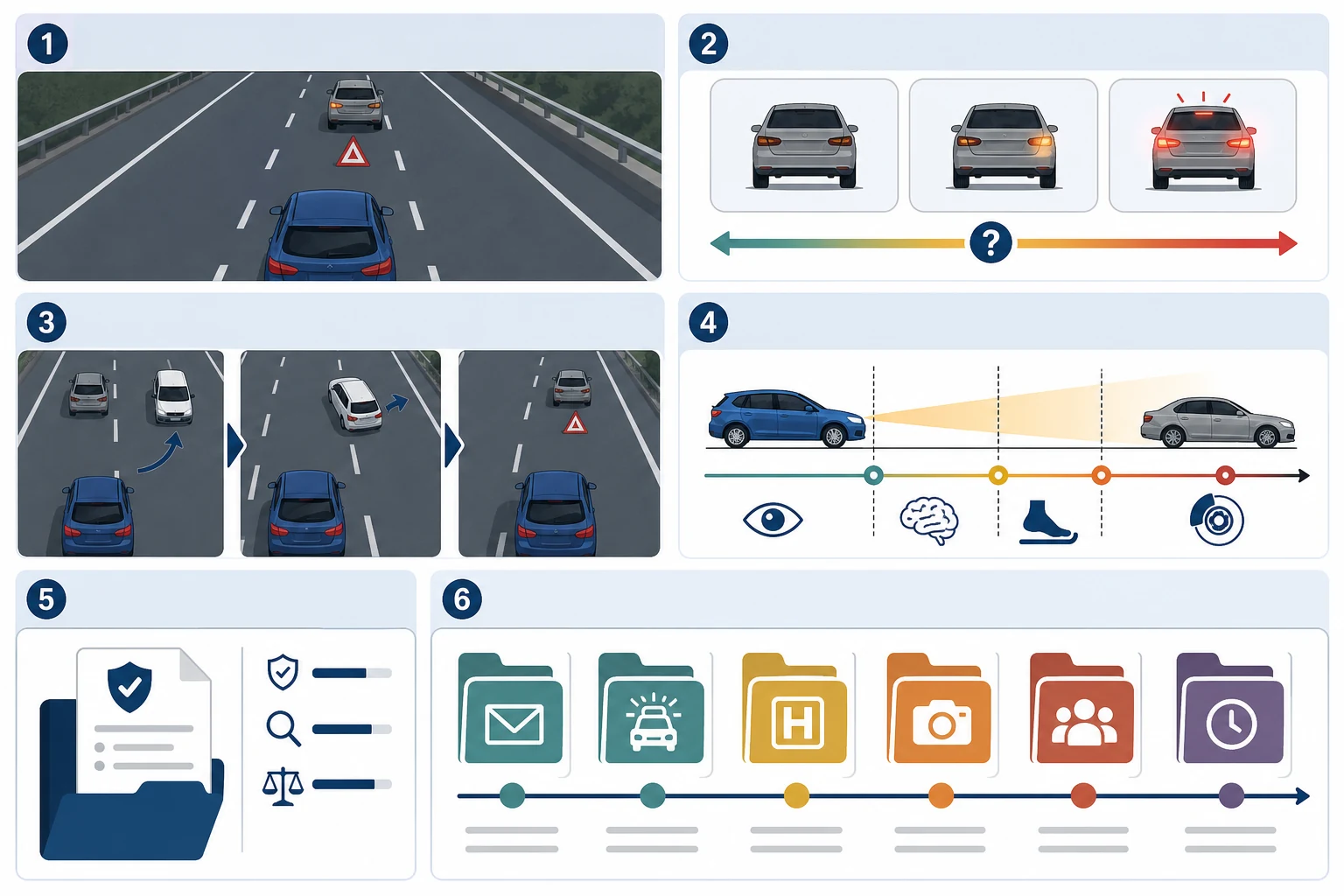
- 1. Stopped vehicleWas a vehicle stationary in a live motorway lane?
- 2. Warnings?Were hazard lights or other warnings actually visible?
- 3. Lane changeDid the vehicle ahead move suddenly and reveal the hazard late?
- 4. Reaction windowWhen could the danger first reasonably be seen, and when did braking begin?
- 5. Proof burdenCan the insurer prove the accident was caused wholly or mostly by the injured driver’s fault?
- 6. Response bundleKeep the insurer notice, police or event material, ambulance or hospital notes, photos, dashcam and witness evidence together.
/images/visuals/cheng-motorway-mostly-at-fault-evidence-reconstruction.webp, with this visible checklist serving as the accessibility fallback and AI-citable evidence map. Deployment should preserve the article-visual, support-visual, and visuals/ markers on the exact case-note route so live citability checks can distinguish this explanatory evidence map from a decorative image.This is a claimant-friendly summary of the decision, not legal advice. The real citation is Cheng v Insurance Australia Limited t/as NRMA Insurance [2025] NSWPIC 566 (21 October 2025). If an insurer is trying to stop your statutory benefits because you hit the rear of another vehicle, this case is a reminder that labels are not enough, the insurer still has to prove the statutory test under the Motor Accident Injuries Act 2017.
Case note source and analysis
Case note at a glance
This note identifies the source decision before drawing practical lessons. It should be read with the full judgment or PIC decision and the current NSW CTP legislation, Guidelines and insurer/PIC pathway that apply to the individual claim.
- Full case name
- Cheng v Insurance Australia Limited t/as NRMA Insurance
- Neutral citation
- [2025] NSWPIC 566
- Court or PIC division
- Personal Injury Commission of NSW, Motor Accidents Division
- Decision date
- 21 October 2025
- Decision-maker
- Senior Member Brett Williams
- Issue
- Whether a rear-end collision with a stationary vehicle meant the claimant was wholly or mostly at fault for statutory benefits purposes.
- Authoritative decision
- Cheng v Insurance Australia Limited t/as NRMA Insurance [2025] NSWPIC 566
- Author / reviewer
- Herman Chan; reviewed by Stephen Young Lawyers
- Date last checked
- 24 June 2026
Material facts
- The claimant collided with a stationary vehicle on a motorway after a traffic hazard developed ahead.
- The insurer relied on the rear-end impact to allege the accident was caused wholly or mostly by the claimant’s fault.
- The evidence required analysis of visibility, reaction time, warning lights, traffic movement and the statutory burden on the insurer.
Decision
The Commission did not accept that the insurer had proved the accident was caused wholly or mostly by the claimant’s fault.
Legal principle
A rear-end impact is not an automatic mostly-at-fault finding. The decision-maker must assess the whole accident mechanism and the insurer’s proof under ss 3.11 and 3.28 of the Motor Accident Injuries Act 2017.
Limitations of the decision
This was a PIC Member decision on its own facts. It does not mean rear drivers are never mostly at fault, and it does not replace evidence about speed, lookout, warnings, road conditions or reaction time.
Practical significance
Claimants should answer a rear-end fault allegation with a short chronology, scene evidence, vehicle-position evidence, witness material, dashcam/CCTV if available and the insurer’s exact statutory reasoning.
What happened in Cheng?
Mr Cheng was injured on the Hume Motorway at Wilton on 1 October 2023. The insurer accepted statutory benefits for the first 52 weeks, then denied benefits after that point on the basis that the accident had been caused wholly by his fault under ss 3.11 and 3.28 of the Motor Accident Injuries Act 2017.
The factual issue was more complicated than a simple rear-end crash. Another vehicle was stationary in the motorway lane. According to the decision, hazard lights were not activated, and the vehicle immediately in front of Mr Cheng changed lanes suddenly, which affected when he could first perceive the stopped vehicle.
The key legal point in plain English
The PIC did not accept that a rear-end impact automatically proved the claimant was wholly or mostly at fault. The insurer carried the burden of proof. It had to persuade the Commission that, on all of the evidence, the accident was caused wholly or mostly by Mr Cheng’s own fault.
Senior Member Williams referred to authorities including Podrebersek, Axiak v Ingram, Allianz v Shuk, and AAI v Evic. One practical takeaway is especially useful for claimants: relative culpability cannot be assessed the way insurers often want unless there are at least two culpable parties in the frame.
Why the insurer lost
- the stopped vehicle was a motorway hazard in the travel lane
- hazard lights were not activated on that stationary vehicle
- the vehicle in front of Mr Cheng changed lanes suddenly, obscuring and then revealing the danger late
- Mr Cheng braked once the hazard became visible
- the evidence did not prove he failed to exercise reasonable care in the circumstances
That combination mattered. The case did not turn on an abstract idea that following drivers are always to blame. It turned on what could actually be seen, when it could be seen, and whether the insurer had proved unreasonable driving by the claimant.
Why Cheng is useful for real disputes
Claimants often receive insurer decisions that feel mechanically reasoned: rear-end crash, therefore fault; fault, therefore benefits stop. Cheng shows why that approach can be wrong. The statutory test is about whether the accident was caused wholly or mostly by the claimant’s fault, not whether the claimant happened to strike the rear of something.
If the hazard was obscured, if another vehicle moved unexpectedly, if a stopped vehicle was left in-lane without proper warning, or if the factual reconstruction is incomplete, the insurer may not be able to prove the high-fault conclusion it wants.
Claimant takeaway
Do not assume a rear-end collision ends the argument. In stopped-vehicle motorway cases, timing, visibility, lane movements, warning lights, and contemporaneous records can completely change the analysis.
How to use Cheng in a NSW CTP mostly-at-fault dispute
Cheng is most useful when an insurer relies on the shape of the crash rather than a complete reconstruction. It does not remove the need to drive with reasonable care, and it does not guarantee benefits in every rear-end collision. It does, however, give claimants a practical way to test whether the insurer has proved the whole statutory conclusion.
- Ask whether the insurer identified the actual negligent act, not just the fact of impact.
- Separate the conduct of the stopped vehicle, any vehicle that changed lanes, and the injured driver’s reaction window.
- Check whether the insurer has evidence about hazard lights, visibility, traffic speed, following distance, and the first moment the danger could reasonably be seen.
- Use the issue early if the insurer proposes to stop statutory benefits under ss 3.11 or 3.28 after the first 52 weeks.
For wider context, see our guides to contributory negligence in NSW CTP claims, CTP claim disputes, and PIC dispute resolution guidelines.
How to read an insurer decision after Cheng
A useful first check is whether the insurer has identified a real act or omission that made you mostly responsible, rather than treating the collision pattern as the answer. In a stopped-vehicle motorway dispute, the decision should grapple with the stopped vehicle, warning lights, lane changes, sight distance, traffic speed, braking evidence, and the point at which a reasonable driver could first detect the hazard.
If the notice simply says you hit the rear of a vehicle, ask for the evidence behind the reconstruction. That may include photographs, police material, dashcam footage, statements from the stopped vehicle or vehicle ahead, repair-location evidence, and any expert assumptions about perception and reaction time. The question is not whether the impact was frightening or serious. The legal question is whether NRMA, AAMI, Allianz, QBE, GIO or another CTP insurer can prove the statutory fault threshold it relies on before stopping benefits.
This matters most around the 52-week statutory-benefits point. If weekly payments or treatment expenses are being stopped, keep the insurer notice, request the factual material promptly, and align the response with the weekly payments stopped dispute guide, internal review, and PIC pathway.
What to gather if you are fighting this issue
- the insurer denial or cessation notice
- police event and any infringement material
- hospital and ambulance records describing the crash mechanism
- photos, dashcam, or witness evidence about the stopped vehicle and lane movements
- your own clear timeline of when the hazard became visible and what you did next
Evidence map for this route
Keep the argument narrow: this page is about stopped-vehicle motorway fault reasoning. The most citable evidence points are the stationary hazard, whether warning lights were visible, the sudden lane change by the vehicle ahead, the seconds available to perceive and brake, and whether the insurer can prove ss 3.11 or 3.28 rather than merely label the crash as a rear-end collision.
For readers wanting the source decision, AustLII is here: Cheng v Insurance Australia Limited t/as NRMA Insurance [2025] NSWPIC 566.
Trust and compliance notes
- This route has a deliberately narrow intent: it explains one PIC case note about rear-end motorway fault reasoning, not the whole law of contributory negligence.
- NSW CTP Claim is a trade name of Stephen Young Lawyers; the page is published as general NSW CTP information, not personal legal advice.
- Reviewed against the AustLII decision, ss 3.11 and 3.28 of the Motor Accident Injuries Act 2017, SIRA guidance, and the NSW Personal Injury Commission context on 7 July 2026.
- General information only. The outcome can change if the evidence shows speeding, distraction, unsafe following distance, clear warning lights, or a longer reaction window.
Official references used for this note
Use the source decision together with the official NSW CTP framework. The links below are general official references, not a substitute for advice on your facts.
- Motor Accident Injuries Act 2017 (NSW) for the statutory benefits and fault provisions discussed in the decision.
- SIRA Motor Accident Guidelines for current NSW CTP claims-handling and benefits guidance.
- Personal Injury Commission for the NSW motor accident dispute forum.
Frequently asked questions
- What was decided in Cheng v Insurance Australia Limited t/as NRMA Insurance [2025] NSWPIC 566?
- The PIC decided the 1 October 2023 motorway accident was not caused wholly or mostly by Mr Cheng’s fault for the purposes of ss 3.11 and 3.28 of the Motor Accident Injuries Act 2017. That meant the insurer could not rely on those sections to stop statutory benefits after 52 weeks.
- Why was this decision important for claimants?
- It shows that a rear-end collision does not automatically mean the following driver was mostly at fault. The insurer still had to prove contributory negligence for the motor accident itself, and the Member found the evidence did not establish that here.
- What facts helped Mr Cheng?
- The decision focused on the stationary vehicle being in the motorway lane, hazard lights not being activated, the vehicle ahead changing lanes suddenly, and Mr Cheng having only a short time to perceive and react to the danger.
- Does Cheng mean every rear-end motorway crash is winnable?
- No. Each case still turns on its own facts, road conditions, distances, speed, visibility, and available evidence. Cheng is useful because it shows the insurer carries the burden of proving the claimant was wholly or mostly at fault.
- What should I do if an insurer says I rear-ended a stopped vehicle so I must be mostly at fault?
- Act quickly. Preserve the factual sequence, obtain police and hospital material, identify any sudden lane changes or visibility issues, and use internal review and the correct PIC pathway before the evidence goes stale.