
NSW CTP annual data update: what the latest scheme numbers mean for injured drivers
A claimant-focused reading of the latest NSW CTP annual data: what the report actually says, what it does not say, and what injured people should really pay attention to after a car accident.
General information only, not legal advice.
If you have been injured in a car accident in New South Wales, annual scheme data can still tell you something useful — even if it does not tell you exactly what your claim is worth.
The latest SIRA Annual Report 2024–25 (draft) gives a high-level picture of the NSW CTP system. It does not spell out average payout figures in the extract available here, but it does show how active the scheme is and how closely insurers continue to be supervised.
What the report clearly says
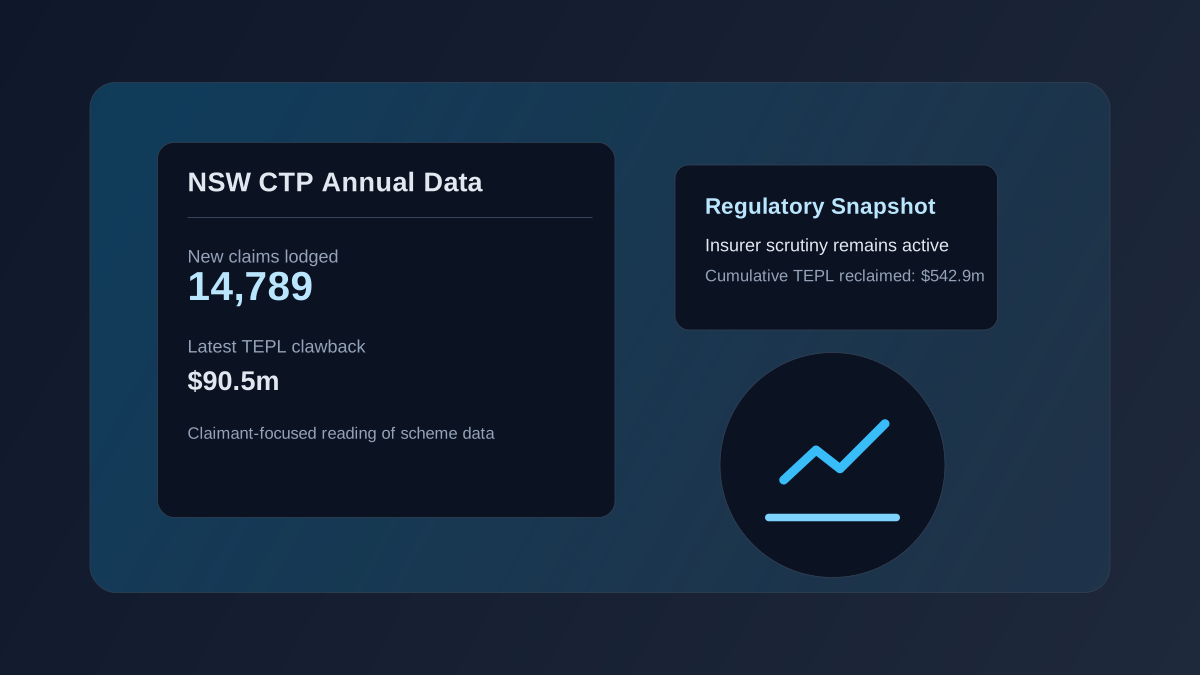
One of the clearest figures in the report is the number of new claims lodged. According to the report, there were 14,789 new CTP claims in 2024–25.
The report also states that in December 2024, SIRA clawed back $90.5 million in excess insurer profit from the 2018 and 2019 accident years under the Transitional Excess Profits and Losses (TEPL)mechanism. It says the total amount reclaimed through TEPL has now reached $542.9 million.
Most injured people will never directly deal with TEPL, but the broader point is important. It shows that the NSW CTP system is not a free-for-all run only by insurers. It is a tightly supervised statutory scheme, and insurer profitability remains under active regulatory scrutiny.
For claimants, the practical takeaway is not that these numbers increase or decrease the value of an individual claim. They do not. But they do show the environment your claim sits in. This is a large, regulated, high-volume system. In that kind of system, claims can become formulaic very quickly unless the evidence is properly prepared and the real issue is identified early.
That is why, after a motor vehicle accident, the details matter so much: your medical records, work capacity evidence, treatment chronology, wage material, and the exact wording of insurer decisions. In a busy scheme, those are the things that usually shape whether your claim moves smoothly or turns into a dispute about PAWE, treatment, threshold injury, or WPI.
It is also worth being careful not to overread the annual report. The extract available here does not clearly provide average payout figures, average weekly benefits, average treatment spend, or average settlement time. So it would be wrong to pretend the report says more than it does. What it really gives us is a reliable snapshot of scale and supervision — not a shortcut to valuing claims.
Bottom line
The best reading of the data is simple: the NSW CTP scheme remains active, closely watched, and highly structured. There are a lot of claims in the system, insurers are still under strong scrutiny, and claimants are best protected when they approach the process with good evidence and a clear dispute strategy if something goes wrong.
Frequently asked questions
- How many new NSW CTP claims were lodged in 2024–25?
- The SIRA Annual Report 2024–25 (draft) states that 14,789 new CTP claims were lodged in that reporting period.
- Does the annual report extract give an average payout figure?
- No. The extract used for this article did not clearly state an average payout, average weekly benefits amount, or average settlement time. This article does not invent those figures.
- Why does the TEPL clawback matter to claimants?
- It matters because it shows insurer profitability remains under active regulatory scrutiny. That does not determine an individual claim value, but it does show the scheme is being supervised at a structural level.
- What should claimants focus on instead of averages?
- Claimants should focus on evidence quality: medical records, work capacity material, earnings documents, treatment chronology, and the exact insurer decision under dispute.
Source note
This article is based on the SIRA Annual Report 2024–25 (draft) extract provided. It uses only figures clearly supported in that source and does not invent average payout or settlement-duration figures where they were not stated.